The myth is that YouTube sponsors start at 10,000 subscribers, or 50,000, or whatever number the last Twitter thread used. The catalogue does not support a universal floor. A company can buy a placement on a small channel. Plenty of companies prefer not to. Those two facts can be true at once, which is why “can I get sponsored with 10K?” is the wrong question. The useful questions are: do small sponsored channels exist in the evidence, what do those rows actually mean, and are you ready to pitch a company that already buys adjacent inventory?
This article reuses the August 2026 channel-metadata cohort already published in How many subscribers do you need to get sponsored on YouTube?. It does not invent a new sample, a conversion rate, or a pay range. It adds the commercial reading: how a small channel should use that range, which public brands are the wrong first target, and when to send the first email.
The subscriber-floor myth
YouTube’s Partner Program overview is about platform monetisation. The 1,000-subscriber number that circulates in creator forums belongs there, not to external brand deals. YouTube’s own brand-deal guidance tells creators to explain the audience, share channel statistics, and propose a credible collaboration. It does not publish an external-sponsorship subscriber cutoff.
Brands invent their own cutoffs anyway. Some media-buying teams filter on subscribers because the number is easy. Some will not look at a channel until median views clear an internal bar. Some specialist advertisers care more about whether the viewer is about to order a PCB, a VPN, or a game key. A public catalogue cannot see those internal bars. It can only show you that sponsorship evidence is not confined to six-figure channels.
What the cohort actually contains
Sponsorbook analysed 14,852 complete subscriber snapshots collected on 25 and 26 August 2026. Every row was a current visible catalogue channel with retained sponsorship evidence. The job was a metadata-coverage refresh, covering about 40% of the 37,388 channels in the customer-visible release. It is not a random sample of YouTube, and the subscriber figure is the current displayed total, not the size of the channel when any sponsorship was arranged.
Twenty-three percent of the cohort sat below 50,000 current subscribers and 38% sat below 100,000. At the other end, 1,791 channels had at least one million. The range is the result. If you are at 8,000 subscribers, you are not imaginary. You are also not the centre of the distribution. Pitch like a specialist, not like a mass-reach buy.
A readiness checklist that is not a subscriber count
- 1Recent comparable views are stable enough to quoteUse a median from a sensible run of long-form videos, with obvious outliers and unrelated Shorts removed if you are selling a long-form integration.
- 2A stranger can name the audience in one sentenceJob, hobby, problem, or buying context. “People aged 18 to 34 who like videos” is not an audience a specialist brand can evaluate.
- 3The product has a home in a video you are already makingIf the integration needs a new show format you have never posted, you are asking the brand to fund a prototype.
- 4Three to five comparable channels already show sponsor evidenceShared subscriber range alone does not make two channels comparable. Use content promise, language, delivery, and integration style. The method is in the similar-channels guide.
- 5You can prove your own channel factsGeography, retention, prior campaign results — only where you actually own the data. Do not paste an industry CPM and hope.
Failing the checklist is information. It usually means the next month of work is content and packaging, not a hundred cold emails. Passing it does not entitle you to a household-name VPN. It entitles you to a short, evidence-backed list.
Niche brands versus household names
The public brand directory is dominated, on 7 October 2026, by high-volume Active buyers: Surfshark, Incogni, Saily, Ground News, Shopify, GamerSupps. Those pages are excellent for learning what dense YouTube buying looks like. They are often the wrong first pitch for a 10K channel, because the named public sample creators sit far above that range.
Look instead at vertical shelves where specialist manufacturers and tools already appear beside smaller named partners. On tech sponsors, PCBWay’s public profile showed 42 sponsored videos across 29 creators in 12 months, with a named partner at 53K current subscribers (Tazer) next to larger channels. Brilliant’s public profile showed 73 videos across 43 creators, including Premature Abstraction at 24K current subscribers. Those subscriber figures are current snapshots on the public page, not the size at booking, and they are still a better qualitative signal than emailing Shopify because you once used the admin.
The same logic applies in games. The gaming category is not only publishers. GamerSupps is a high-volume Active supplement brand; Instant Gaming and Opera GX are Cooling in the same public leaderboard, with Instant Gaming’s latest visible example on 15 May 2026 from Kaganath, listed at 29K current subscribers. A small gaming channel should read Gaming YouTube sponsors before treating “gaming brand” as one buyer type.
Pitch timing for a small channel
Early outreach should be narrow. You do not have a media-kit industrial complex. You have a handful of episodes and a reputation you cannot afford to cheapen. Use the similar-channel method to build ten rows, then the research-backed email template to convert the best row into one observation, one owned audience fact, and one video.
Time the send to your calendar, not to a mythical “brands buy in Q4” rule you cannot source. If you have a series premiere, a seasonal project, or a video that naturally features the product, say so. If you do not, wait until you do. A small channel’s advantage is specificity. Do not trade it for volume. Public creator profiles are another way to inspect evidence at a given size. The Chrome extension keeps that lookup on the tab you are already watching; MCP is the same research from an assistant. If you are choosing a research product rather than a marketplace, compare Sponsorbook first.
- Do not apologise for your size in the first line. Lead with the evidence and the episode. The median views belong in the proof paragraph, not the subject line as a confession.
- Do not invent a larger competitor set. If your true comps are 20K–80K channels, those are the comps. Borrowing a million-subscriber roster makes the mismatch obvious.
- Do not quote a catalogue fee. Sponsorbook does not publish what anyone was paid. Quote a rate only when you can scope deliverables from your own numbers.
Frequently asked questions
Can you get YouTube sponsors with 10K subscribers?
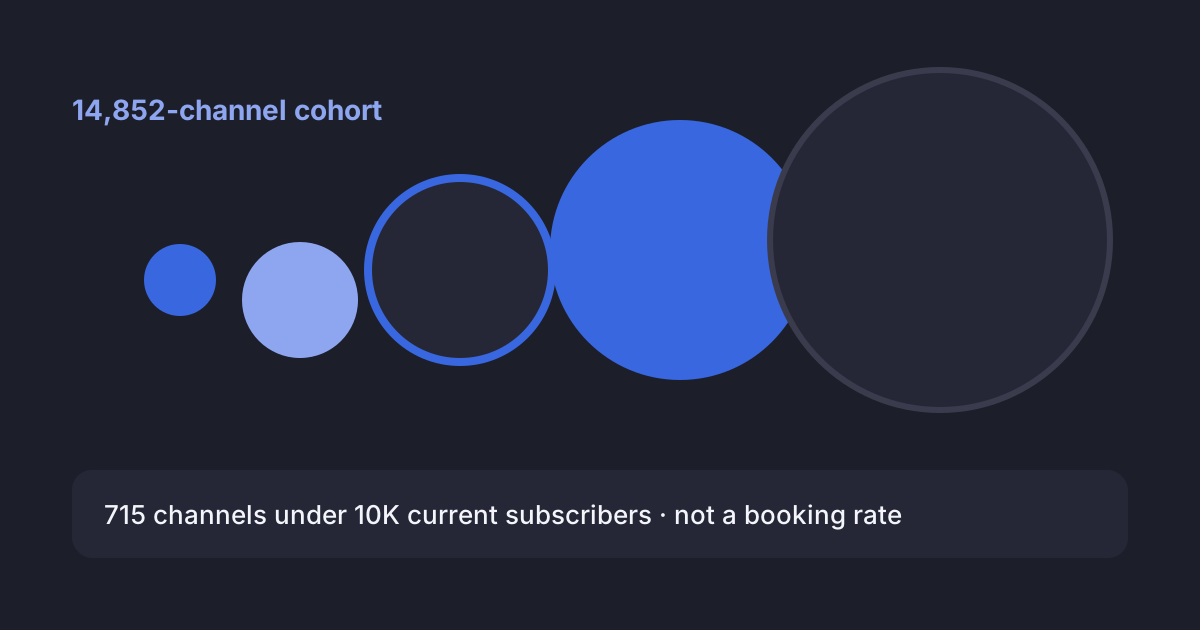
There is no platform-wide subscriber floor for a direct brand deal. A 14,852-channel Sponsorbook coverage cohort from 25–26 August 2026 contained 715 channels then below 10,000 current subscribers, and 34 below 1,000. That proves small sponsored channels exist in the catalogue. It does not estimate your probability of being booked.
Is the YouTube Partner Program the same as getting a sponsor?
No. The 1,000-subscriber figure people quote is a YouTube Partner Program eligibility rule for platform monetisation features. External brand partnerships are a separate commercial judgement made brand by brand.
Should a small channel pitch Surfshark or Shopify first?
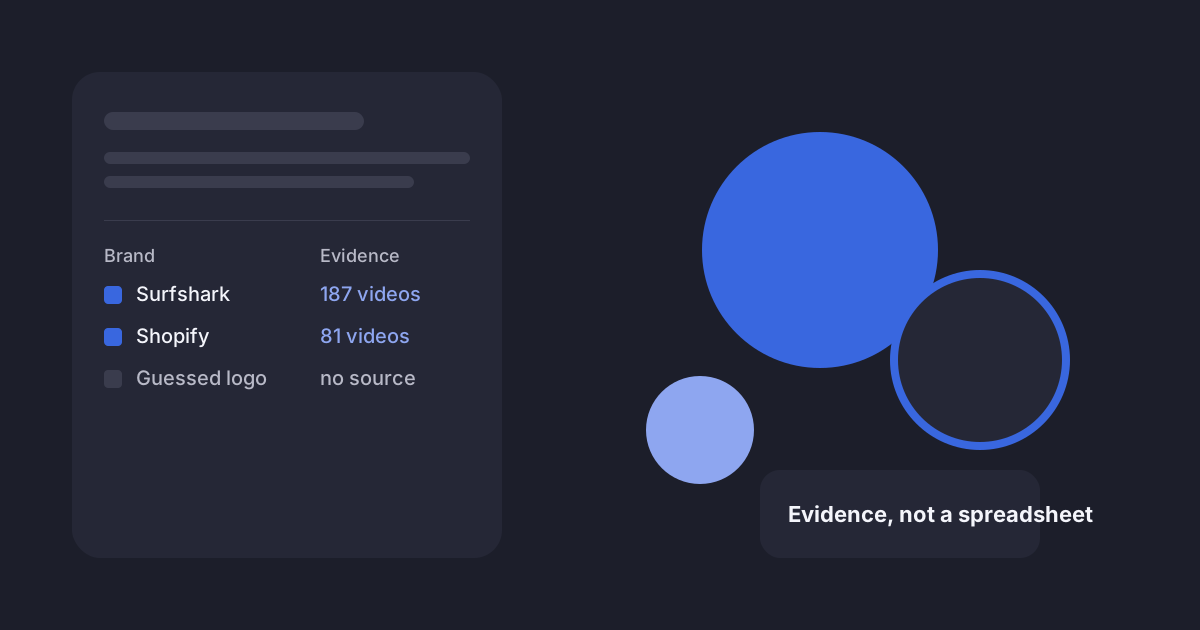
Not by default. Household-name Active buyers such as Surfshark (187 sponsored videos / 100 creators in 12 months) and Shopify (81 / 42) are visible on the public directory, but their sample creators on those pages are large. Specialist brands in tech manufacturing, learning, or gaming tools often show smaller named partners. Pitch the company whose recent videos look like yours.
When should a small channel start outreach?
When you can pass a readiness check — stable recent views, an audience you can describe in one sentence, a product that belongs in a real video, comparable channels with evidence — and you have a short list of companies with current adjacent placements. Ten researched names beat a hundred famous ones.
Methodology and limits
Subscriber cohort figures are unchanged from the 25–26 August 2026 channel-metadata refresh (14,933 attempted rows, 14,852 complete, 81 transient failures). Public brand examples and current-subscriber labels on named creators were re-checked on 7 October 2026. They remain current-snapshot illustrations, not reconstructions of deal-time audience size. No figure in this article is a booking probability, a fee, or a recommendation to email a specific company.
Sources
- How many subscribers to get sponsored on YouTube
- How to find YouTube sponsors using similar channels
- Tech brands sponsoring YouTube
- Gaming brands sponsoring YouTube
- PCBWay YouTube sponsorships
- Brilliant YouTube sponsorships
- Sponsorbook public creator directory
- YouTube Partner Program overview
- YouTube: Tips for getting brand deals
- Sponsorbook Chrome extension
- Sponsorbook MCP