Sponsorbook’s 25 August 2026 release contains 449,537 customer-visible sponsored videos across 37,388 YouTube channels and 21,246 brand identities. Those totals establish the scale and breadth of the observable catalogue. They do not establish that the market grew by a particular percentage in 2026.
Only 66,847 of 449,547 videos in the immutable release ledger had publication dates at finalisation. That is enough for inspected examples and bounded date-aware slices, but too little for a clean platform-wide comparison between 2025 and 2026. This report publishes what survives the audit and leaves the growth headline blank.
The current catalogue at a glance
The first structural finding is range. More than 21,000 resolved brands appear across more than 37,000 channels. The market cannot be understood from a short list of household-name sponsors or top creators. Research needs both directions: which channels a brand appears around, and which brands appear around a creator.
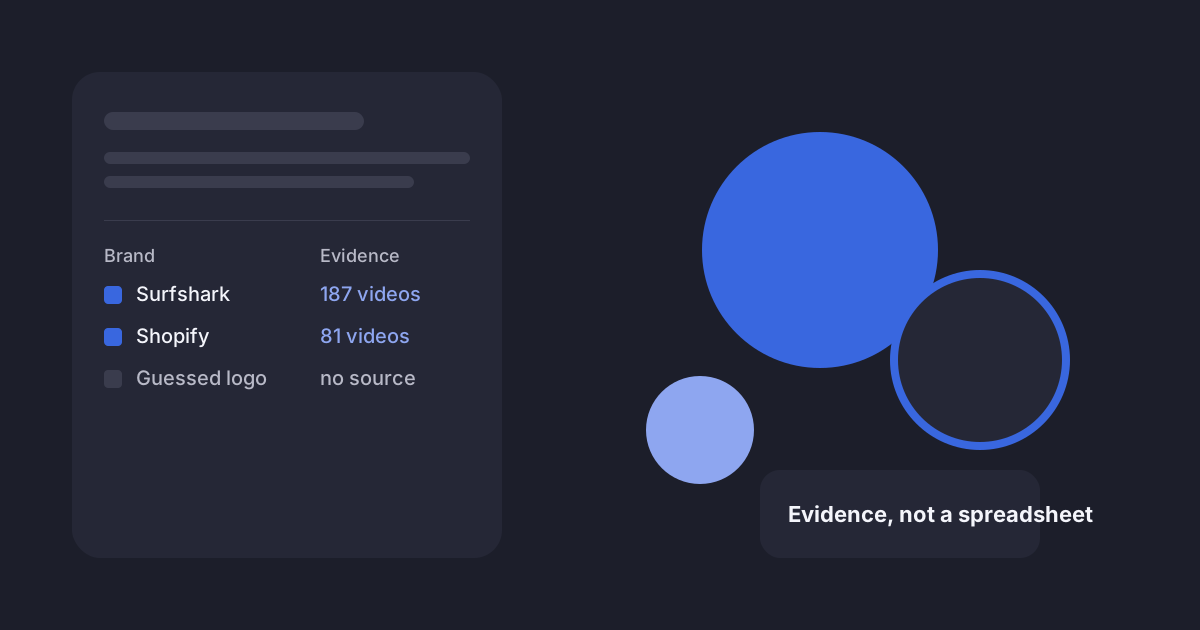
The second structural finding is that videos and sponsorship records are different denominators. A single video can contain evidence connected to more than one brand or retained sponsorship segment. Reporting 544,521 “deals” would erase that distinction and imply contract knowledge the catalogue does not have.
Brand identity is a major part of market measurement
Sponsor names arrive in inconsistent forms: product names, parent companies, regional domains, tracking links, transcription errors, and abbreviations. Before publication, the identity process merged 373 cases into existing brands and excluded 6,987 unresolved identity cases from the catalogue. A rule that looked safe in a dry run was also withheld after regional and non-English examples showed that it could expose weak identities.
This matters strategically because a sponsorship trend can be manufactured by identity drift. Splitting one advertiser into five names inflates active-brand counts. Merging distinct regional products can hide real variation. A reliable market report needs identity decisions, versioned publication, and reversible suppression alongside the final chart.
Channel-size analysis is possible only with visible coverage
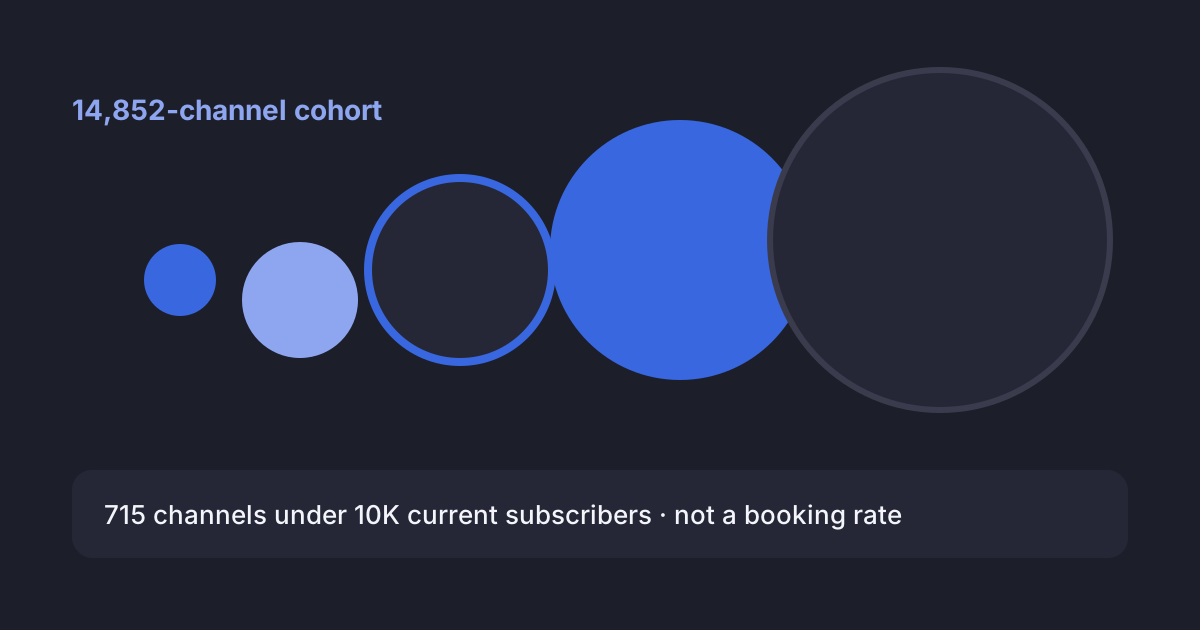
At release time, 23,029 of 37,389 ledger channels had follower counts. A separate bounded refresh collected 14,852 complete current subscriber snapshots for channels that previously lacked retained profile metadata. That second cohort contains sponsored channels from below 1,000 current subscribers through more than one million, but its selection by missing metadata prevents a market-share interpretation.
The full distribution and the exact caveat are published in How many subscribers do you need to get sponsored on YouTube? The safe conclusion is that observed sponsorship evidence spans a wide current audience range. The data does not provide a universal threshold or the channel size at the time a relationship was arranged.
Why this report does not claim year-over-year growth
A credible year-over-year result would require equal date windows, stable detection coverage, explicit missing-date treatment, and a sensitivity check that removes the largest advertisers. It would also separate unique creators from sponsored videos and first observed brand-creator relationships from first-ever commercial relationships. The current release cannot meet all of those conditions across the full catalogue.
The decision to withhold a growth rate is itself useful. Large catalogue totals make weak trend claims look authoritative. The correct denominator, field coverage, and publication process matter more than the largest headline number.
What creators and agencies can use now
- Brand activity research: Inspect current public profiles and dated sponsored-video evidence instead of assuming a famous advertiser remains active.
- Adjacent-channel prospecting: Use shared sponsor history to find companies already buying around a comparable content context, then verify the fit manually.
- Repeat-evidence review: Treat repeated appearances as a reason to inspect the relationship, not as proof of campaign performance or a retainer.
- Coverage-aware reporting: Put the missing fields and denominator beside every chart so a current snapshot does not become a historical claim.
The public brand directory and creator directory expose capped, inspectable records from the current snapshot. They are useful entry points for named examples. The full catalogue supports deeper lookup and evidence review.
Methodology and limits
Catalogue figures come from the audited 25 August 2026 release, dataset overlap-islands-v1-1785543480680:luna-1869992:identity-v10, finalised at 19:39:36 UTC. Source and published ledger counts reconciled before two reversible brand hides reduced the customer-visible projection by two brands, 11 sponsorship records, ten videos, and one channel. The release processed 1,869,992 event decisions and deliberately deferred 2,038,684 corpus events. Sponsorbook’s unit is public sponsorship evidence attached to a YouTube video. No figure in this article represents a signed contract, price, advertiser spend, creator earnings, conversion, or return on investment.